
One of the first things affiliate marketers learn is that traffic matters.
No traffic means no visitors. No visitors means no leads. And without leads, it’s pretty difficult to make sales.
So naturally, when the sales aren’t coming, many marketers reach the same conclusion:
“I need more traffic.”
Sometimes they do.
But sometimes more traffic is the last thing they need.
If 500 people visit your page and nobody takes action, sending another 5,000 people to the same page may simply give you 5,000 more people who don’t take action.
Before chasing more clicks, it’s worth looking at what happens after the click.
Traffic Is Only the Beginning
Think of traffic as getting someone through the front door.
Once they arrive, several things have to happen.
They need to understand what you’re offering. They need a reason to care. They need enough trust to continue. And most importantly, they need to know what you want them to do next.
If any of those pieces are missing, even good traffic can produce disappointing results.
That’s why successful affiliate marketing isn’t simply:
Traffic → Sale
It usually looks more like:
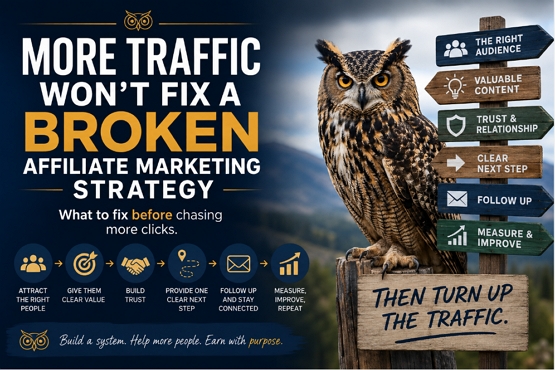
Attention → Interest → Trust → Action → Follow-Up → Sale
And sometimes that journey takes five minutes.
Sometimes it takes five weeks.
1. Make Sure Your Message Matches Your Audience
You can have a great offer and still show it to the wrong people.
Imagine promoting an advanced email automation platform to someone who hasn’t even built their first email list yet.
It may be an excellent product.
It just isn’t solving the problem that person has right now.
Before promoting an affiliate offer, ask yourself:
Who is this for, and what problem are they trying to solve?
Then build your message around that problem rather than simply listing the product’s features.
People aren’t usually looking for another tool, course, program, or membership.
They’re looking for a result.
2. Give People a Reason to Trust You
Affiliate marketing has changed.
Years ago, you could sometimes throw an affiliate link in front of enough people and generate sales.
Today, people are exposed to offers constantly.
That makes trust increasingly important.
One of the best ways to build trust is also one of the simplest:
Be useful even when someone doesn’t buy anything.
Teach something.
Answer a question.
Share an experience.
Explain a mistake you’ve made.
Compare options.
Help someone avoid a problem.
When people repeatedly receive value from you, you’re no longer just another person dropping affiliate links.
You become a resource.
And resources get remembered.
3. Stop Trying to Promote Everything
This is one of the easiest traps in affiliate marketing.
You join one program.
Then another looks interesting.
Then somebody sends you a message about the “next big thing.”
Before long, you’re promoting six programs, four traffic sources, three AI tools and something you joined Tuesday night but can’t quite remember what it does.
Sound familiar?
Opportunities aren’t necessarily the problem.
Lack of focus is.
You don’t have to promote only one product, but the products you promote should make sense together.
Ideally, they should serve the same audience or solve related problems.
That creates something much more powerful than a collection of affiliate links.
It creates an ecosystem.
4. Have One Clear Next Step
Never make your visitor guess what to do.
Do you want them to:
Join your email list?
Watch a video?
Read a review?
Create a free account?
Purchase a product?
Pick the most important next step and make it obvious.
Giving someone seven choices can feel helpful, but too many choices often result in no choice at all.
Clarity converts.
5. Don’t Forget the Follow-Up
This may be one of the biggest missed opportunities in affiliate marketing.
Someone clicks your link but doesn’t buy.
What happens next?
If the answer is nothing, you’re starting from zero every time you generate traffic.
That’s expensive and inefficient.
Whenever possible, build a way to continue the relationship.
That might be an email list, community, social media connection, newsletter, or another channel where people can continue hearing from you.
A person who isn’t interested today may be interested next week.
Or next month.
But only if they can still find you.
6. Measure More Than Sales
Sales are obviously important.
But they aren’t the only number worth watching.
Pay attention to:
- Clicks
- Opt-ins
- Conversion rates
- Email opens
- Link clicks inside emails
- Which traffic sources produce engagement
- Which content generates responses
- Which offers actually convert
Those numbers can tell you where the problem is.
For example, if nobody clicks your ad, the problem may be the ad.
If people click but don’t opt in, the problem may be the landing page.
If they opt in but never open your emails, your subject lines or follow-up may need work.
If they read and click but don’t purchase, the offer itself may be the problem.
That’s much more useful than simply saying:
“Affiliate marketing isn’t working.”
Build a System, Not Just a Collection of Links
The goal isn’t to become better at posting affiliate links.
The goal is to build a simple system that continues working as you improve it.
Create useful content.
Attract the right people.
Give them a clear next step.
Stay connected.
Recommend products that genuinely fit their needs.
Track what happens.
Improve what isn’t working.
Then—and only then—turn up the traffic.
That’s how affiliate marketing begins to move away from constantly chasing the next click and toward building an actual business.
One Wise Thought
Before you look for your next traffic source, take ten minutes and look at your current marketing as if you were seeing it for the first time.
Ask yourself:
“If I clicked this today, would I immediately understand what’s here, why it matters to me, and what I should do next?”
If the answer is yes, then more traffic might be exactly what you need.
If the answer is no, you’ve just discovered something far more valuable than another thousand clicks:
You’ve discovered what to fix next.