
Stop sharing
ten links.
Share one.
Your One Wise Link puts every business you promote behind a single link — plus the training to build a real foundation, and a referral program that pays you for sharing it.
Join OWL Free →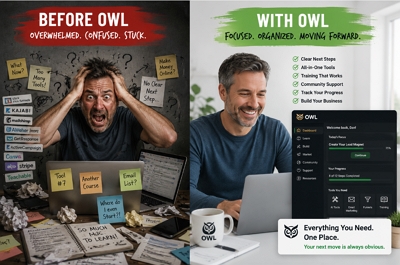
Most people don’t fail online because they’re lazy. They fail because they’re scattered — too many links, too many tools, no clear next step.
Your One Wise Link brings every business you promote into one place, so people only ever need one link to find everything you’re building.
Everything you need, none of the guesswork.
OWL is built around three things — not a comp plan looking for a reason to exist.
1. One Link, Every Business
Promote everything you’re part of behind your One Wise Link — no more juggling ten different URLs for ten different programs.
2. A Real Business Foundation
The 90-day training teaches skills that work for any business you ever promote — not just how to use OWL.
3. Get Paid To Share It
Refer people to OWL itself and earn commissions on their membership. Optional — not required to get value.
Skills that work for any business you promote.
The 90-day foundational training isn’t a walkthrough of OWL’s dashboard — it’s how to actually build an online business: traffic, lead generation, funnels, and using A.I. well. Apply it to OWL, to another program, or to something entirely your own.
- ✓ A real foundation, not just OWL onboarding
- ✓ Learn traffic and lead generation
- ✓ Use A.I. more effectively
- ✓ Apply it to any business you promote
Tools first. Opportunity second. Value always.
See how OWL combines practical tools, structured training, and community into one platform.
Built to be seen — not just used.
Your ads and reviews don’t stay locked behind a login. They’re public, so members and everyday visitors see them — and Google can pick them up too.
📢 Advertise Your Way
Promote your programs and products in multiple ways — every ad is seen across the platform by members and public visitors alike.
- Banner ads
- Button ads
- Text ads
- Solo ads
⭐ Program Reviews
Write a real review of any program you are familiar with, with your affiliate link included if you choose. Reviews are public pages — built to be found by search engines and visitors, not just other members.
- Public review pages
- Your affiliate link, optional
- Findable on Google, not just OWL
Three steps. That’s it.
Start Free
Join at no cost, explore the platform, and get your referral link right away.
Upgrade to Pro
(optional)Unlock the full 90-day training, advanced tools, and referral commissions.
Build & Share
Apply the training, promote your link, and grow at your own pace.
The optional referral side of OWL.
Use OWL to build your own business — and if you choose, share it with others. Eligible Pro members earn direct commissions on people they personally refer.
Opportunity Highlights
- $25 Fast Start bonus potential
- 65% recurring commission on referrals’ monthly membership
- Director benefits for serious builders
- Build in before full public launch momentum
Choose how you want to begin.
Start free, look around, and decide if OWL belongs in your online marketing journey.
Basic access with your referral link and selected member resources.
- Referral link access
- Public profile page
- Selected tools and resources
- Daily email updates
- View program reviews
- Optional referral earnings
Then $15/month starting month 2.
- Everything in Free
- Earn commissions on your referrals
- Full 90-day success training
- Advanced A.I. marketing tools
- Advertising and promotion options
Don’t take our word for it.
Real members, sharing real experiences building with OWL.
What Our Members Are Saying

I’m 72 years old and not very technical, so finding something that’s simple and easy to follow means everything to me. One Wise Owl Links...

I’ve been using One Wise Link (OWL) for a few months now, and I absolutely love this app! 🚀 It has helped me learn skills...

I'm impressed with this program. There are so many tools that are available for even a free member. I have never seen a program like...

“I’ll be honest, I was nervous getting started because technology and online marketing are very new to me. What I like about OWL is that...
Your online marketing journey needs a wise guide.
Get the tools. Follow the training. Join the community. Build at your pace.
Start Free Today →Important: One Wise Link (OWL) provides tools, training, community support, and optional referral opportunities. Earnings are not guaranteed and will vary based on individual effort, skill, consistency, and market conditions.
Participation in the referral program is optional. Members can benefit from the platform without referring others. OWL is not a “get rich quick” program and does not make income guarantees.